

Semiconductor stocks have emerged as the primary beneficiaries of the increasing investment in artificial intelligence (AI) infrastructure over the past three years, marking a significant trend in the tech industry.
When investors consider the realm of AI hardware stocks, Nvidia understandably takes the spotlight. However, beneath the surface, another semiconductor giant is making remarkable progress. Advanced Micro Devices (AMD -0.52%) has evolved from being a long-standing competitor in graphics processing units (GPUs) and central processing units (CPUs) to a formidable leader in AI accelerators. These are high-performance chips crucial for training and deploying large language models (LLMs) and generative AI applications.
With an expanding lineup of state-of-the-art processors and strategic partnerships with major cloud providers, AMD is positioning itself as a significant player in the forthcoming wave of AI infrastructure growth.
Discover AMD’s Competitive Edge in the AI Accelerator Market
While Nvidia remains the unquestionable leader in the AI hardware market, AMD is swiftly closing the gap. The company’s Instinct MI300 chip architecture has demonstrated its capability to compete at the highest performance levels, and the anticipated MI400 accelerators are expected to introduce substantial enhancements in memory capacity, energy efficiency, and throughput.
These improvements are not merely theoretical; leading hyperscalers like Microsoft and Meta Platforms have already begun incorporating AMD’s chips into their next-generation data center developments as a viable alternative to Nvidia’s GPUs. This shift signifies a growing trend in the industry.
By adopting open-source standards such as ROCm, AMD is fostering a more adaptable ecosystem, allowing developers to transition and optimize models effortlessly across various platforms. Their clear message to customers is compelling: achieve cutting-edge AI performance without the constraints of a single vendor’s proprietary ecosystem or the limitations posed by Nvidia’s supply chain and pricing.
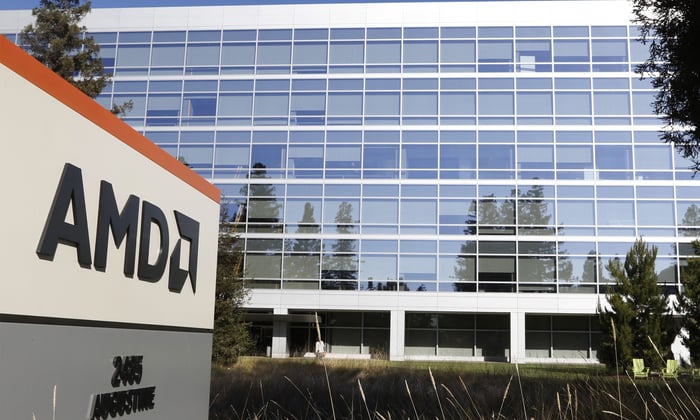
Image source: Advanced Micro Devices.
Major Partnerships Signal AMD’s Growing Momentum in AI Hardware
The most significant endorsement of AMD’s advancements in AI hardware comes from two of the industry’s most influential players: OpenAI and Oracle.
Recently, OpenAI revealed a groundbreaking 6-gigawatt data center collaboration to power its next generation of models using new architectures built on AMD accelerators. Just a week later, Oracle disclosed that its cloud infrastructure division plans to deploy 50,000 Instinct MI450 chips in the latter half of next year, showcasing a strong commitment to AMD’s technology.
These landmark partnerships underscore two critical insights. First, AMD has demonstrated its ability to provide AI computing power at hyperscale capacity. Second, the price-performance metrics of its chips are now competitive enough to attract leading cloud providers and AI developers.
However, these agreements signify more than just impressive numbers; they indicate a fundamental shift in the AI infrastructure market. Major cloud players are diversifying their GPU supply chains to meet an unprecedented surge in demand for computational resources, and AMD’s capacity to deliver large-scale, cost-efficient accelerators positions it as a crucial element in this strategy. This trend acknowledges that the future of AI hardware will likely consist of a multivendor landscape, with AMD emerging as a pivotal force driving this transformation.
Building a Comprehensive AI Ecosystem: Software and Startups
AMD recognizes that having superior hardware is insufficient to lead in the AI revolution. Therefore, the company has been diligently investing in software, developer tools, and research frameworks that facilitate the adoption of its chips across diverse enterprises and data centers.
Strategic acquisitions such as Nod.ai and Silo AI have significantly enhanced AMD’s capabilities in optimization, model deployment, and integration—essential tools for developers aiming to build and scale applications on AMD’s platforms.
Concurrently, the company is reaping the benefits of a burgeoning AI startup ecosystem that complements its product strategy. Startups like Groq are driving up the overall demand for specialized computing while establishing new benchmarks for inference performance and energy efficiency.
As the industry transitions toward flexible AI infrastructure, AMD’s Instinct accelerator platform is well-positioned to capture an increasing share of the market. In essence, AMD is not merely supplying chips; it is constructing a comprehensive foundation that aligns with the next phase of data center innovation.
How Should Investors Evaluate AMD Stock Going Forward?
For investors, AMD presents a compelling blend of growth potential and solid market validation. The company has shown that it can effectively compete against Nvidia while maintaining a consistent pace of innovation, with its next-generation MI450 chips poised to make a significant impact in the upcoming year.
Although there may be near-term volatility due to the substantial capital investments required in the semiconductor industry, AMD’s long-term outlook appears bright. The company has transitioned from being an underdog to becoming a foundational pillar in the AI infrastructure buildout that will shape the future of computing over the next decade.
For long-term investors who believe that the AI boom is just beginning, AMD stands out as one of the premier AI hardware stocks to consider acquiring today—a company that seamlessly bridges world-class engineering with the expanding real-world demand across cloud computing, data centers, and generative AI models.
Adam Spatacco has positions in Meta Platforms, Microsoft, and Nvidia. The Motley Fool has positions in and recommends Advanced Micro Devices, Meta Platforms, Microsoft, Nvidia, and Oracle. The Motley Fool recommends the following options: long January 2026 $395 calls on Microsoft and short January 2026 $405 calls on Microsoft. The Motley Fool has a disclosure policy.


