

- The Masterpiece homeowners policy from Chubb provides comprehensive coverage for properties valued at over $1 million.
- This policy guarantees coverage for the cost to rebuild or repair your home, even if expenses exceed the policy’s limit.
- If you decide not to rebuild or repair the property, you can receive a cash payout settlement up to the policy limit.
- The policy also includes coverage for traumatic events such as child abduction and home invasions.
- This insurance is generally more expensive than average, primarily targeting high-end customers.
- Chubb does not provide online quotes and only sells its products through local insurance agents.
KEY HIGHLIGHTS
- Financial rating:
- Superior (A++) on A.M. Best
- Available Discounts:
- Discounts offered for security and safety systems, new or renovated homes, gated communities, loyalty, claim-free status, autopay, electronic billing, alarm systems, and more.
- Bundling Options:
- Includes auto, renters, life, and umbrella insurance.
Why we selected Chubb: The Masterpiece policy offered by Chubb comes with distinctive advantages that go beyond typical homeowners insurance. This includes risk consulting services, coverage for hijacking, home invasions, and more. A notable feature is the option for policyholders to choose a cash settlement up to the policy’s limit if they opt not to rebuild after damage occurs, or if they prefer to relocate. Additionally, Chubb’s private flood insurance outperforms industry norms, providing coverage for homes up to $15 million against flood damage, significantly higher than the NFIP’s $250,000 maximum.
While these exceptional benefits are appealing, they do come at a higher price. Chubb is recognized as one of the most expensive home insurance providers available. Nonetheless, for those whose budgets accommodate its rates, it presents an excellent option. Notably, Chubb consistently ranks within the top three in J.D. Power Customer Satisfaction Surveys year after year and boasts one of the lowest NAIC complaint indexes among the insurers we evaluated.
- Services are available in 47 states and Washington, D.C.
- Ranks above average in J.D. Power’s Property Claims Satisfaction Study.
- Collaborated with Wildfire Defense Systems to offer complimentary fire prevention and risk management.
- Offers a wide range of coverage types, making it ideal for bundling discounts.
- Fewer available discounts compared to other major insurers.
- Insurance products can only be accessed through State Farm agents.
- Currently, not accepting new applications from residents in California.
KEY HIGHLIGHTS
- Financial rating:
- A++ (Superior) on A.M. Best
- Discounts:
- Bundling, home security systems, and resistant roofing.
- Bundling options:
- Auto, renters, life insurance.
Why we selected State Farm: State Farm stands as the largest home insurance company in the United States, providing a diverse array of policies, including life, auto, and condo insurance. This variety enables customers to bundle their policies, yielding substantial discounts while enjoying a more streamlined experience.
However, a downside of State Farm is its reliance on captive agents for sales. Nevertheless, its network is extensive, with estimates suggesting close to 19,000 agents across nearly every state, making it convenient for potential clients to find assistance with their applications.

Insurance Companies We Evaluated
The following insurance providers did not meet one or more criteria outlined in our evaluation methodology, yet they still offer features and benefits that may be suitable for certain customers.
Continue reading to discover if one of these insurers aligns with your unique requirements.
Lemonade Insurance
Reason for exclusion: Lemonade Insurance operates exclusively online and utilizes artificial intelligence to deliver swift home insurance quotes. However, this company has received a concerning number of complaints registered with the NAIC in relation to its relatively small market share, as it only operates in 30 states.
Erie Insurance
Reason for exclusion: Erie Insurance is recognized as one of the leading insurers for customer service and claims satisfaction in the country. Unfortunately, it is only available to homeowners in 12 states along with Washington D.C.. If your property is located in a state served by Erie, be sure to obtain a quote to determine if it suits your needs.
For more details, read our comprehensive review of Erie Homeowners Insurance.
Allstate
Reason for exclusion: Allstate did not qualify for our list due to slightly lower ratings in customer satisfaction and overall features compared to its competitors. Furthermore, it has recently announced it will no longer accept applicants from the state of California.
Your Guide to Understanding Homeowners Insurance
Homeowners insurance provides a type of property insurance that offers financial compensation if your home sustains damage due to covered natural disasters, theft, or accidents. It’s worth noting that this type of insurance typically does not cover flooding or earthquakes, which necessitate separate coverage options.
Understanding the Costs of Home Insurance
The premiums for home insurance differ significantly among various companies and are also influenced by the property’s location, style, square footage, and age. Personal factors, including your credit score and claims history, will also play a role in determining your rates.
According to a report by the Consumer Federation of America (CFA), homeowners on average paid over $3,000 to insure their properties, reflecting a concerning increase of 24% since 2021. Overall, the report identifies Florida, Louisiana, Oklahoma, Kentucky, and Nebraska as the most costly states for home insurance. Notably, Utah experienced the sharpest premium increase, soaring by 59%.
Maximizing Your Home Insurance Discounts
One of the most frequently offered discounts by insurance providers is the multi-policy discount or bundling discount, which can save you over $1,000 annually in some instances.
Insurance companies may also lower your rates for setting up automatic payments, opting for electronic statements, paying the full annual policy cost upfront, insuring a newly built home, or even for installing protective devices such as burglar alarms and smoke detectors.
Key Coverages Included in Homeowners Insurance
Most standard homeowners insurance policies typically include the following coverages:
- Dwelling coverage: This component protects the main structure of your property — specifically, the actual house — from ten basic perils: fire, lightning, hail, windstorms, explosions, civil unrest, aircraft damage, vehicle damage, smoke damage, vandalism, theft, and volcanic eruptions.
- Personal property coverage: This typically covers personal belongings up to a certain percentage of your overall home insurance coverage. This percentage varies by policy. Homeowners are advised to consider adding coverage for valuable items such as jewelry, art collections, and other high-value possessions.
- Personal liability coverage: This provides liability protection for injuries incurred by non-residents while on your property. Depending on the policy specifics, it may cover medical expenses and legal costs.
- Other structures coverage: This protects detached structures, such as fences, gazebos, or tool sheds, from damages caused by covered perils.
- Additional living expenses (ALE) or loss of use coverage: If a covered loss renders your home uninhabitable, most homeowners insurance policies will reimburse you for temporary lodging, like hotels or rental accommodations, up to your coverage limits.
Common Exclusions in Homeowners Insurance Policies
The perils listed in the following table are typically excluded from standard homeowners insurance policies.
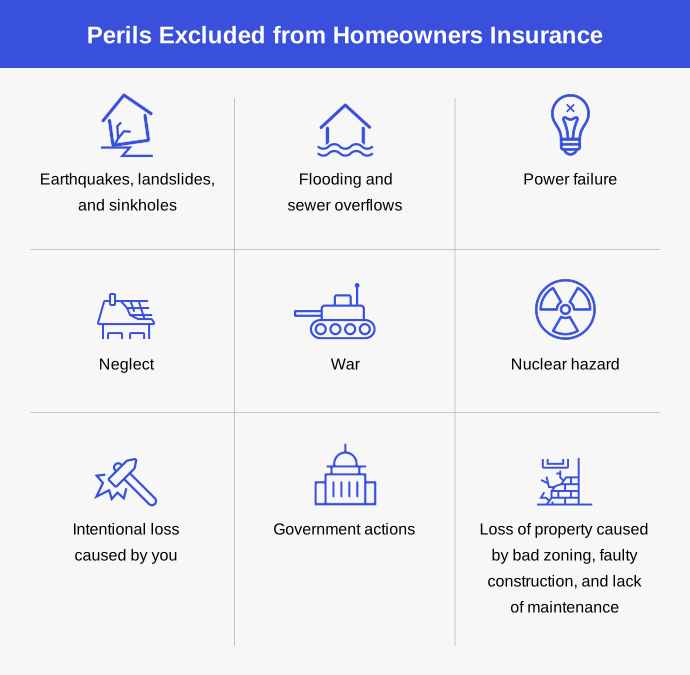
Additional Weather-Related Exclusions
While floods are generally excluded from standard home insurance policies, you will need to purchase flood insurance if the Federal Emergency Management Agency (FEMA) designates your property as being in a flood zone.
The National Flood Insurance Program (NFIP) offers flood insurance for property owners, renters, and businesses in over 23,000 participating NFIP communities. Visit FloodSmart.gov for further information.
Most homeowners insurance policies will cover water damage that results from a covered peril (e.g., a car accident damaging a pipe). However, if the water damage stems from causes not included in the policy, such as a hurricane, water backup, or a DIY home renovation mishap, it will not be covered.
Depending on your location, there may be additional weather-related exclusions. For instance, homeowners’ insurance policies for properties located on the coast in Texas do not cover wind or hail damage.
In certain Eastern coastal regions, hurricanes and windstorms come with a unique deductible based on a percentage of your chosen coverage amount, often regulated by state laws. For specific state information, visit the Insurance Information Institute.
Typically, earthquake damage is excluded from standard homeowners insurance policies. Coverage for this peril can be obtained through a rider or a separate policy. It’s advisable to consult the largest earthquake insurer in your state, such as the California Earthquake Authority.
Most home insurance policies cover wildfire damage. However, some companies have ceased offering this coverage in areas with a high risk of wildfires or have made adjustments related to this specific peril. It’s wise to check with local insurance providers to see if they continue to offer wildfire coverage in your region or to consider alternatives such as your state’s FAIR Plan (e.g., California FAIR Plan).
For more comprehensive information, read our detailed guide on how homeowners’ insurance works.
Choosing the Right Homeowners Insurance for Your Needs
To select the best homeowners insurance provider, consider several critical factors. These include the price of the policy, the coverage it provides, the value of your home and personal belongings, and more.
Evaluate Your Home Insurance Requirements
Before choosing the appropriate type and level of coverage, assess your specific home insurance needs. Consider the following:
- Your location: If you reside in a flood-prone area or states like Florida or California, where natural disasters frequently occur, you may require additional coverage.
- Home features: If your residence is a historic building or has undergone recent, costly renovations, you may require a policy that offers a guaranteed replacement cost to facilitate rebuilding your home as closely as possible to its original state.
- Your possessions: Create an inventory of your belongings and consider investing in additional coverage for valuable items such as jewelry or collectibles. While most policies will cover personal belongings, limits typically apply, and high-value items may not be fully covered.
Explore Additional Coverage Options
Depending on your circumstances, standard insurance products may not provide sufficient protection.
Investigate the types of endorsements — often referred to as insurance riders or add-ons — that each insurer provides. While these may increase your annual premium, they could be worthwhile if they help safeguard valuable assets like jewelry or collectibles.
Some companies also offer coverage for more specific issues, including water damage, identity theft, cybersecurity threats, and even kidnapping.
Identify the Best Homeowners Insurance Providers in Your State
The next step is to identify both national and local insurers operating in your state. Once you have a list, request multiple quotes and evaluate their coverage options, financial strength ratings, customer satisfaction scores, complaints, and more.
While national carriers often have strong brand recognition and larger market shares, smaller regional providers may offer superior customer service, personalized coverage, and competitive rates.
You can find insurance providers in your state or county through your local government’s insurance department; their contact details can be accessed on the pages of the National Association of Insurance Commissioners (NAIC) or the Insurance Information Institute.
Frequently Asked Questions About Homeowners Insurance
What is the average cost of homeowners insurance?
The typical cost of homeowners insurance in the United States averages around $1,200 per year or $100 per month. However, rates for homeowners’ insurance can vary significantly based on your home’s unique circumstances, the extent of coverage you desire, and your geographical location.
Is homeowners insurance mandatory?
While homeowners insurance is not mandated by state or federal law, almost all lenders require it as part of your mortgage agreement.
Does homeowners insurance cover mold damage?
Typically, mold damage is covered by homeowners insurance if the cause is a peril that is included in your policy. However, if the mold results from an excluded peril (like flooding) or homeowner negligence, coverage will not apply.
What about coverage for water damage in homeowners insurance?
Most homeowners insurance policies will cover water damage caused by a peril included in the policy (for instance, a vehicle accident damaging a pipe). However, if the cause is an excluded event such as a hurricane or a DIY home renovation error, coverage will not be provided.
What is the 80% rule in homeowners insurance?
However, even having a policy that covers 100% of your home’s value does not guarantee that the insurer will cover the entire amount necessary for repairs. It’s essential to read your policy closely and consult with an agent if you have any questions.
Which home insurance company is the best?
Focusing solely on customer satisfaction, the leading home insurance companies include Amica Mutual and Erie Insurance. However, Lemonade and Hippo provide streamlined claims processing and enable you to acquire coverage online in a matter of minutes. Ultimately, the ‘best’ insurer will depend on your specific needs and location, as not all companies are available nationwide.
Criteria for Selecting the Best Homeowners Insurance Companies
To identify the leading homeowners insurance companies, we evaluated several key factors.
- Customer satisfaction: We examined the findings from J.D. Power’s 2025 U.S. Property Claims Satisfaction Study and the 2024 U.S. Home Insurance Study to assess customer satisfaction levels among the insurers on our list. Additionally, we reviewed the NAIC Complaint Index for selected subsidiaries with significant shares in the homeowners insurance market. With few exceptions, we prioritized companies with above-average J.D. Power ratings and a low NAIC complaint index.
- Financial stability: We analyzed financial ratings from organizations like A.M. Best and Demotech to confirm that the companies we selected are financially robust and capable of fulfilling their insurance commitments.
- Coverage options: Coverage options tend to be similar among insurers. We specifically noted companies that offered flood insurance and other riders, such as extended replacement cost coverage and the option for cash settlements.
- Market presence: Our top selections emphasized carriers that are available nationwide and possess a substantial market share. For this evaluation, we referenced the NAIC’s 2024 Property/Casualty Market Share report.
Recent Developments in Homeowners Insurance
The latest report from Money highlights findings from the most recent J.D. Power Property Claims Satisfaction Study: Although home insurance premiums are on the rise, and the industry is enjoying significant profits, customer satisfaction is declining. Many clients express frustration regarding slow service, particularly concerning claims and repairs that linger for over a month. Moreover, even clients who have not filed claims are experiencing premium increases, contributing to growing dissatisfaction with their insurance providers.
According to A.M. Best, the insurance sector’s standard for financial stability, the National Oceanic and Atmospheric Administration (NOAA) intends to phase out a crucial database that assists insurers in determining pricing and risk evaluation. This database has tracked climate-related disasters resulting in damages of at least $1 billion for over 40 years. It serves as an indispensable tool, particularly as the frequency and intensity of extreme weather events continue to rise. Finding a replacement will be challenging as the NOAA’s database, established in 1980, would take years to replicate.
Frequently Asked Questions About Homeowners Insurance
Is homeowners insurance mandatory?
Homeowners insurance is not legally required by state or federal regulations. However, almost all lenders will necessitate homeowners insurance as part of your mortgage agreement.
Does homeowners insurance cover mold damage?
As with many issues, mold damage is covered under homeowners insurance if the cause is a peril included in your policy. If the mold arises from an excluded peril (like flooding) or homeowner negligence, coverage will not apply.
What is the 80% rule in homeowners insurance?
Most insurers follow the 80% rule, which states they will reimburse you for the full cost of damages to your home only if your coverage is at least 80% of the property’s value.
Even a policy that covers 100% of your home’s value does not guarantee full payment from the insurer for necessary repairs. It’s crucial to read your policy carefully and consult an agent if there are any questions.
Overview of Money’s Top Homeowners Insurance Companies for 2025
- Amica Mutual – Best Overall
- AIG – Best for High-Value Homes
- USAA – Top Choice for Military Members
- Chubb – Best for Diverse Coverage Options
- State Farm – Ideal for Bundling Policies


